Online CNA to LPN Programs: Finding Your School
The following professionals lent their expertise to this article:



 Healthcare Nursing Healthcare Admin Editorial Senior Care Dementia Care
Making the move from certified nursing assistant (CNA) to licensed practical nurse (LPN) can be great for your career, but how do you get there? Which education programs make the most sense for you, and what does it take to apply, enroll, and graduate? Let EduMed walk you through CNA to LPN programs available online, and help you narrow down your search for the best school.

Achieve Test Prep
PROGRAM: LPN to RN/BSN
We help thousands of LPNs/LVNs work towards achieving their Associate Degree in Nursing or RN. The Test-Out Bridge Program makes achieving your RN faster and affordable, and previous college credits will count toward your advanced degree.
What the Experts Say: How to Find the Right CNA-to-LPN Bridge Program for You
The programs listed in this guide represent quality pathways for CNAs ready to advance to licensed practical nursing. Taking that next step is a bigger commitment than CNA training, and the right bridge program depends on where you are in your career, how much time you can dedicate, and what kind of schedule support you need. Our experts share what to weigh before making the leap.
Ask Your Employer First
Before you enroll in a bridge program, ask your current employer if they offer any form of tuition assistance for aspiring LPNs. Many healthcare organizations have these benefits, but don’t advertise them after you’re already an employee. I’ve seen some employers cover the full cost of LPN training in exchange for a modest work commitment.

Understand Your New Responsibilities
I’ve worked with many CNAs who doubted whether they were capable of becoming nurses, only to thrive once they entered an LPN program. But understand that the transition from CNA to LPN brings a new level of clinical accountability and legal responsibility, so go in ready to think differently about your role at the bedside.

FAQs for Online CNA to LPN Bridges
How long will it take me to go from CNA to LPN online?
Most CNA to LPN bridge programs take nine to 12 months of full-time study. Part-time students can expect to be in school for 24 months. The time it takes you depends upon several factors, such as whether you prefer full-time or part-time study and whether you choose an accelerated option.
Keep in mind that this only includes the program. You will need additional time to study and take the NCLEX-PN to become licensed as an LPN.
How much do online CNA to LPN bridge programs cost?
Here are the tuition rates at a few schools to give you a better idea of what to expect to pay for your LPN training.



The cost of your LPN program depends greatly on several factors, such as how long it takes you to complete it, how much funding you’ve secured to pay tuition, and of course, the cost of tuition itself.
Some schools have a flat rate for all online students. Others charge in-state tuition to give online students a financial incentive to attend that school. Even the type of school matters; a private school tends to be more expensive than a public one, although you need to be a resident student to make the most of a public school’s in-state tuition privileges.
Will I get credit for the CNA classes and training I’ve already completed and be able to apply them towards my LPN program?
Yes, possibly, depending on the transfer policies of your LPN program. If you took full-credit college courses in pursuit of your CNA, your LPN program will likely accept your CNA coursework as transfer credits.
However, most CNA programs are very short and result in a certificate of completion, which might not provide any credits to transfer. To be sure, speak with the financial aid officer and academic advisor at the school you’re planning to attend. They can look at your transcripts and help you answer the question about transfer credits before you enroll in a CNA to LPN bridge program.
Will online CNA to LPN programs qualify me to take the NCLEX-PN exam?
Yes, they should if they have programmatic accreditation. All accredited LPN programs are designed to prepare you for this important exam. Some programs might even include courses that focus on getting ready for the test through a review of skills and knowledge.
Always double-check that your school will qualify you for the NCLEX-PN exam. This is a crucial point to be certain of before enrollment, as taking the NCLEX-PN is necessary to become an LPN.
How Do Online CNA to LPN Programs Work?
Certified Nursing Assistants already have a strong foundation of real-world medical knowledge and skills, and the LPN curriculum builds off that. Online CNA to LPN bridge programs can be found at community colleges, trade schools, and even hospitals.
Programs offered as an online/hybrid option include virtual instruction on topics that don’t need hands-on work, such as ethics or basic anatomy. If students are near a campus, they might be expected to complete in-person simulated courses.
For students further away from campus, they may complete hands-on requirements while working on their clinicals, which can be completed at an approved facility close to the student’s location. Some CNAs may be able to complete their clinicals where they are currently working.
Regardless of the online CNA to LPN bridge program they attend, students can expect online courses to have the same rigor and demand the same commitment as in-person courses. To learn more about going from a CNA to an LPN, check out our LPN page.
What nursing skills and knowledge will I gain in a CNA to LPN online program?
Skills and information you will learn during your LPN training include:
- How to fully participate with a nursing team in a variety of tasks, including conducting assessments and planning, implementing, and evaluating nursing care for patients.
- How to use effective communication skills to assist patients and families within the scope of your LPN practice.
- How to apply basic principles of nursing to determine the appropriate care and actions for patients and their families.
- The best ways to safely implement evidence-based practices in the nursing setting and to keep abreast of trends and emerging technology.
- The expectations for displaying responsibility and accountability as a nurse by meeting ethical and legal standards.
The Importance of Accreditation
When choosing the best school, either online or on campus, one of the most important points to consider is accreditation. Accreditation means a school or program has undergone a rigorous evaluation by an independent accrediting body and is found to meet specific standards of education quality.
Attending a school that meets accreditation standards ensures that your degree, diploma, or certificate will be accepted by employers or other institutions of higher learning as a valid credential. Accreditation is also required to receive many forms of financial aid.
Regional or national accreditation is awarded to the school and focuses on the institution as a whole.
Programmatic accreditation focuses on programs in a certain field. LPN programs are accredited by the Accreditation Commission for Education in Nursing (ACEN). To determine if a school has regional accreditation, visit the Department of Education’s Database of Accredited Postsecondary Institutions and Programs.
Financial Aid for Your Online CNA to LPN Program
Becoming an LPN might garner more responsibility and a higher paycheck, but both of those benefits mean little if you can’t afford the cost of an LPN program. Thankfully, financial aid can help cut down on tuition costs to make your CNA to LPN bridge program more affordable.
Here are some ways to get financial assistance for your CNA to LPN program:
1. Scholarships & Grants
These are financial aid awards that don’t have to be paid back. This is as close to “free money” as you can get for your education, and these financial aid awards are among the most sought after by students.
Scholarships can be found on a variety of websites or directly from organizations related to nursing. Use our scholarships guide for LPN students to help you find the scholarships and grants best for you, and don’t forget to apply early to improve your chances.
2. Student Loans
Student loans that come from the federal government usually offer low interest rates and deferred interest. This makes it easier to borrow the money you need for costs that other financial aid doesn’t cover. Apply for loans when you get your tuition bill after scholarships and grants are applied. To learn more, check out our student loan guide.
3. Other Financial Aid Options
There might be other options for financial aid, such as work-study or internships.
Sometimes, employers will help pay for a student’s education. Check with your employer to see if this is included in your benefits package and what the terms and conditions are for using these benefits. For example, if your employer pays for part of your schooling, you may be required to continue working for them for a certain amount of time after graduation.
Some options, such as work-study, might not translate to online learning if you live too far away from campus for regular trips. Check with your school for options that might work for you.
Salary and Career Prospects for LPNs
U.S.
Alabama
Alaska
Arizona
Arkansas
California
Colorado
Connecticut
Delaware
District of Columbia
Florida
Georgia
Hawaii
Idaho
Illinois
Indiana
Iowa
Kansas
Kentucky
Louisiana
Maine
Maryland
Massachusetts
Michigan
Minnesota
Mississippi
Missouri
Montana
Nebraska
Nevada
New Hampshire
New Jersey
New Mexico
New York
North Carolina
North Dakota
Ohio
Oklahoma
Oregon
Pennsylvania
Rhode Island
South Carolina
South Dakota
Tennessee
Texas
Utah
Vermont
Virginia
Washington
West Virginia
Wisconsin
Wyoming
Data reflects national numbers, not school-specific information.
United States
Data reflects national numbers, not school-specific information.
Looking Ahead: Advanced Nursing Degrees After CNA to LPN
Once you’ve moved from CNA to LPN, that doesn’t have to be a final stop for your nursing career. There are more steps you can take to advance your career in the nursing field.
These programs are offered in an online or hybrid format to help you get there as conveniently as possible.
- Online LPN to BSN Programs
Once you have the LPN, you can move into a bachelor’s in nursing program. By building on the credits earned during your LPN and the experience you’ve gained as a practicing LPN, this program boosts your options for advancing into positions in the healthcare system with added responsibility. To learn more, visit our online LPN to BSN programs page. - Online LPN to RN Programs
LPNs work under the supervision of registered nurses. RNs have more autonomy in handling patients, including the ability to order tests, administer medications, and work closely with physicians to create a treatment plan. Earning a registered nursing degree can open doors to higher pay and challenging positions. Look at our online LPN to RN programs page for more. - Online RN to MSN Programs
Registered nurses who want to move into advanced practice, management, research, or education can earn their master’s degree and make those dreams a reality. The master’s program is often entirely online and is designed for working registered nurses. Visit our online RN to MSN page to learn more.
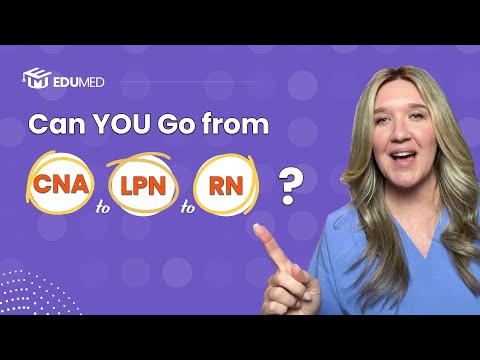
Video Overview: CNA → LPN → RN Pathway
See how the stepwise nursing pathway works and who benefits most from each stage.